


Few areas of biology are moving faster right now than spatial profiling. For decades we ground tissue into a tube and measured an average, losing exactly the thing that makes tissue interesting: where each cell sits, and who its neighbors are. Spatial transcriptomics gives that context back, and it is reshaping how researchers study tumor microenvironments, immune infiltration, and disease boundaries.
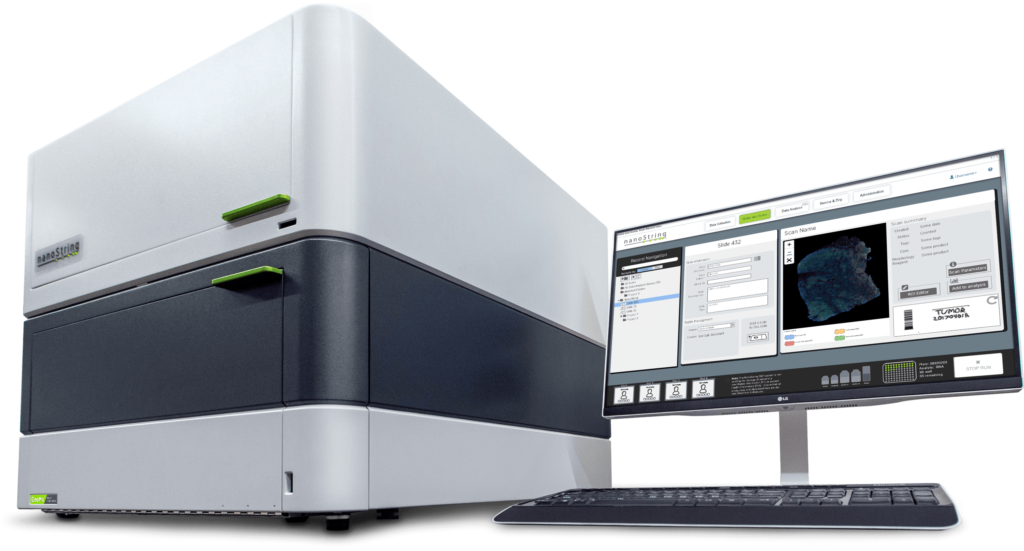
Today we're excited to bring one of the most powerful spatial platforms into Rosalind: NanoString GeoMx Digital Spatial Profiler (DSP). You can now take a GeoMx experiment from raw DCC files all the way to biological insight in a single guided workflow, without stitching together a pile of scripts, and without losing spatial context along the way.
A guided path from import to insight
The new GeoMx workflow walks you through every step, in order, so nothing gets skipped:
- Import & panel detection. Upload your DCC files and lab worksheet, and Rosalind auto-detects your panel type and validates the file structure. Comma-separated panel codes and the latest worksheet format are supported, and duplicate sample identifiers across slides are handled automatically.
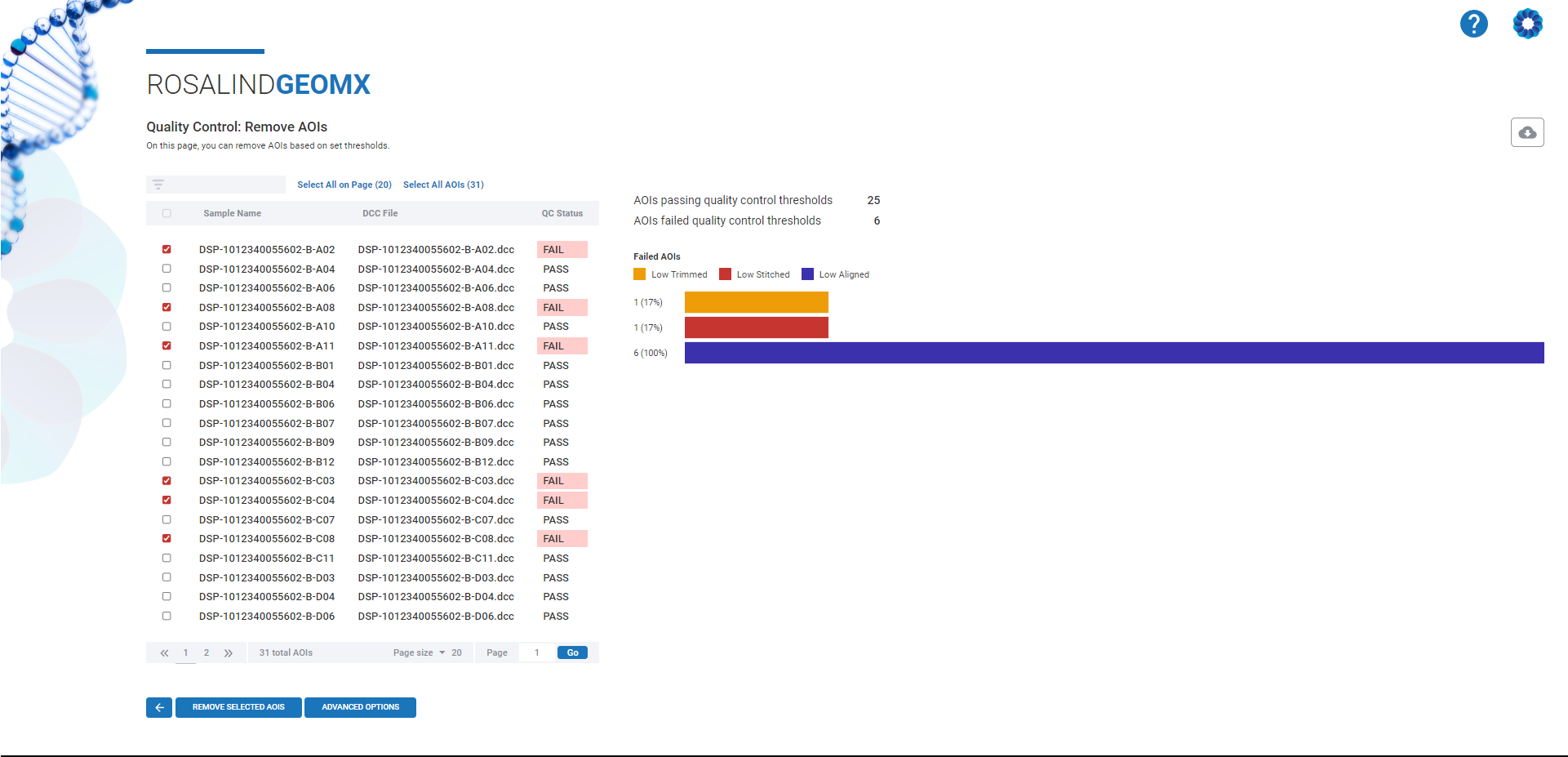
- AOI & segment QC. Review segment-level quality in an interactive table with clear pass, warn, and fail indicators, backed by QC graphs across your areas of interest. Underperforming AOIs can be soft-deleted: excluded downstream, but still there if you want to revisit them.
- Filtering & genes of interest. Keep the segments with sufficient coverage, prune low-detection genes, and define the genes you care about from an existing gene list or inline.
- Normalization & differential expression. Choose your normalization approach (DESeq2, Q3, or background subtraction) and run differential expression with Limma or a Linear Mixed Model. The comparison report tells you exactly which method was applied.
Spatial data as a first-class citizen
What we're most proud of isn't any single step. It's that GeoMx experiments behave like every other experiment in Rosalind. You get full pathway and knowledge-base enrichment on your comparisons, you can download normalized and raw count matrices and source DCC files, and you can even include GeoMx experiments in meta-analyses alongside your bulk data.
Spatial biology is still young, and the tooling has often lagged the science. Our goal is simple: let you spend your time interpreting where biology happens in a tissue, not wrestling with file formats. Bringing a data type this rich into the same rigorous, reproducible home as the rest of your work is also part of something larger we've been quietly building: a disciplined data-science foundation where every kind of data is handled with the same care. That groundwork is what makes everything downstream possible. This is a big first step, and there's much more to come.
.png)