I've written over the past couple of years about a through-line: that rigor is the foundation, that no experiment is an island, and that our field has to move from storing data to reasoning across it. Today I want to name plainly where all of that has been heading, because I think it matters not just for Rosalind, but for the industry.
The idea, stated simply
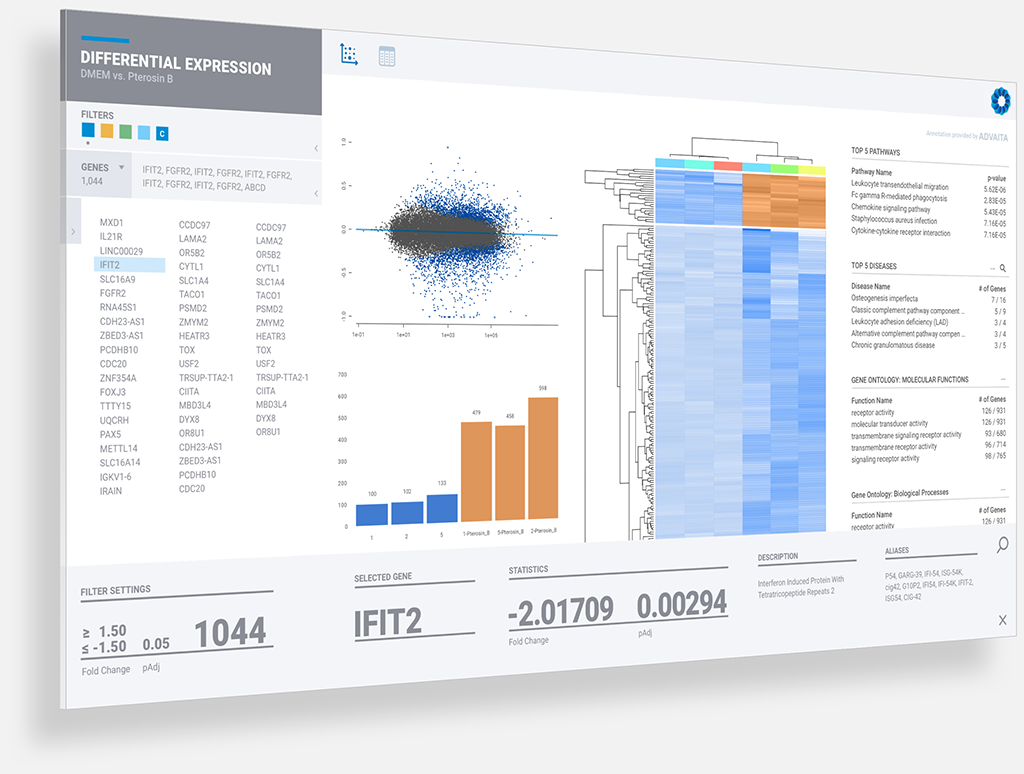
We've been building toward what we call the Rosalind Corpus (a growing, curated, harmonized body of biological data that the platform can reason across, not merely hold) and a broader capability we think of as Rosalind Data Intelligence: the ability to ask real scientific questions of that corpus and get answers grounded in evidence. Let me be precise about what this is and isn't. It's a direction we're building and a foundation we've been laying for years. It is not a magic box, and it is not a replacement for the scientist. It's an instrument for one.
Three forces converging
Three things that used to be separate are arriving at the same moment, and their convergence is what makes this different.
The first is data at scale, finally made comparable. Multiomics (bulk, single-cell, spatial, and more) has given us an unprecedented view of biology, but only if it can be harmonized and set in context. That's the work we've been obsessed with from day one.
The second is AI that can actually help. The tools to read, connect, and reason over biological data at a scale no human can hold have matured to the point of genuine usefulness. Used well, they turn a vast corpus from something you search into something you can converse with.
The third, and the one I care about most, is attestation: every answer able to show its work, traceable to the underlying data and to how that data was produced. This is the difference between intelligence you can build on and a confident guess you can't. In biology, where the stakes are health and years of a career, that difference is everything.
Trustworthy, or it's nothing
Our industry is about to be flooded with promises of AI over biological data. Some will be real; many won't. The dividing line, I'm convinced, is provenance. An intelligence you can't audit is worse than no intelligence at all, because it quietly invites you to act on things you can't verify. So we've made a deliberate choice: no answer without its evidence, no insight without a trail back to how it was made. Trustworthy biological intelligence, or nothing worth the name.
Where this takes us
I think we're at the front edge of a shift as consequential as the move to high-throughput sequencing itself: from data as a byproduct you archive to data as a living asset you reason across. A corpus that grows more valuable with every rigorous experiment added to it. AI that helps you see across it. Attestation that lets you trust what you see. That's the platform biology needs, and it's the one we've quietly been building toward this whole time.
None of this replaces the foundation. It's the reason we built the foundation. Everything disciplined and careful we've done was in service of being able to do exactly this, credibly. That's why we built the Rosalind Corpus, and it's where I believe the industry is going. As ever, thank you for building it with us.